Quick Answer
These mailers generally advertise private life insurance, not a special government benefit. The companies sending them may sell your response to insurance agents, and the coverage you’re offered depends on the agent, the available products, and your health. Before buying, compare your options. You may qualify for first-day coverage instead of a policy with a waiting period.
Key Points
- “State-regulated” sounds official, but it’s just regular private life insurance
- There is no government life insurance program for free funeral expenses
- These ads are designed to look like they are offering state or federal benefits
- You’re still buying a regular policy from a private company & often more expensive
- Most offers are basic burial insurance with high pricing, 2-year waits, & no health questions
- These deceptive ads try to fool you into believing there are free or reduced-price benefits
GET MY QUOTEor call 888-862-9456
The “Benefit Information” mailers
These mailers aren’t a special state program, just private policies being marketed with confusing wording. If you’ve seen a postcard or Facebook ad saying you may “qualify for a state-regulated life insurance program,” you probably wondered if that program was legit.
The most common version of this mailer has a big headline with a year and a state, and often a short code in the corner. Over the years, people have searched for cards headed “Benefit Information for [your state] Citizens Only” or “Residents Only,” because they want to know if the card in their hand is real. Newer cards use the same style. Here’s a real 2026 example:
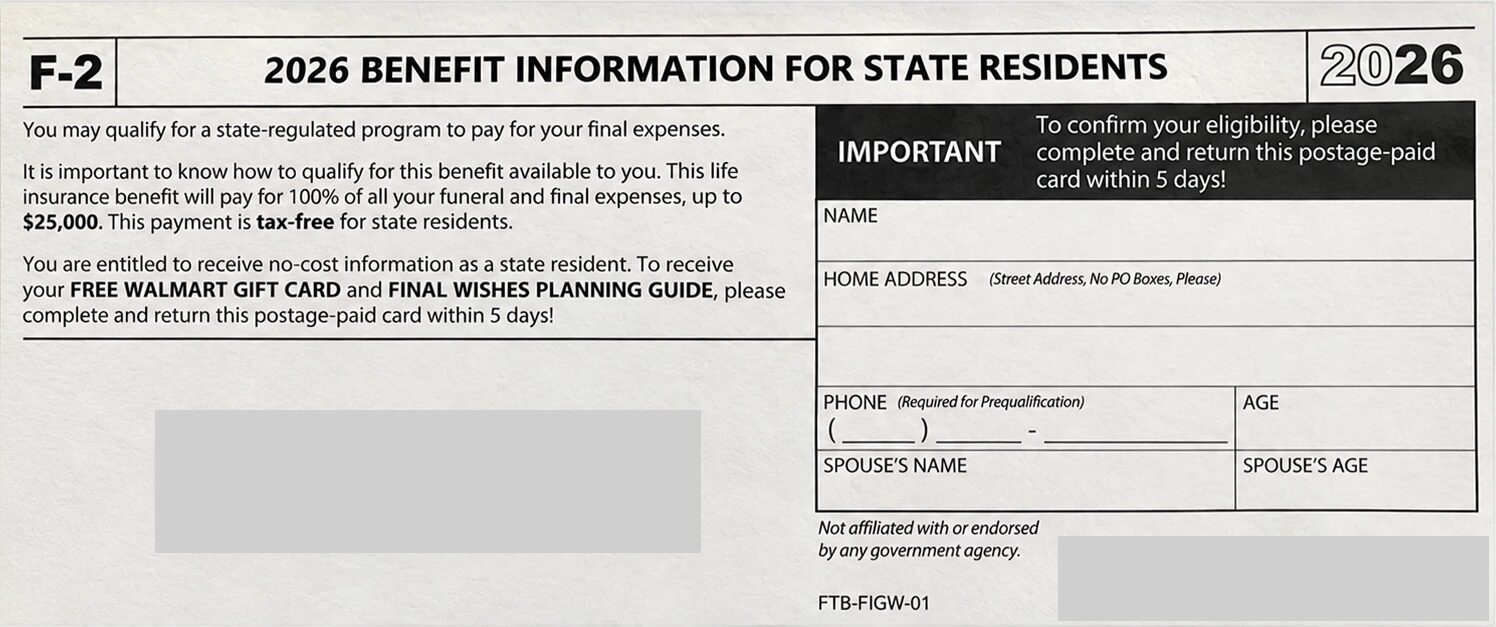
This card says “2026 Benefit Information for State Residents” instead of naming a state, but it works the same way as the “[State] Citizens Only” cards. Here’s what it says, and what it actually means:
| What the card says | What it means |
|---|---|
| “2026 Benefit Information for State Residents” | A headline written to look like an official notice. It names no government agency. |
| “You may qualify for a state-regulated program to pay for your final expenses.” | All life insurance is state regulated. The card doesn’t say what the “program” is or who offers it. |
| “This life insurance benefit will pay for 100% of all your funeral and final expenses, up to $25,000.” | A life insurance policy pays its face amount to your beneficiary. Whether that covers 100% of your expenses depends on how much coverage you buy and what your funeral actually costs. |
| “This payment is tax-free for state residents.” | Life insurance paid to a beneficiary because of a death generally isn’t taxable income, whatever state you live in (IRS Publication 525). It’s not a special benefit for “state residents.” |
| “FREE WALMART GIFT CARD and FINAL WISHES PLANNING GUIDE” | A reason to send the card back. The card doesn’t say who provides the gift card or what you’d have to do to get it. |
| “Return this postage-paid card within 5 days!” | The five-day deadline is a marketing tactic, not evidence that a special government benefit expires. Your age can affect your insurance rate, and waiting until after a birthday may change your premium, but that is different from the deadline printed on this card. |
| Name, home address, phone “(Required for Prequalification)”, age, spouse’s name and age | This is the information an agent needs to call or visit you. A postcard can’t prequalify you. Approval only happens on a real application with an insurance company. |
| “Not affiliated with or endorsed by any government agency.” | The most important line on the card, and the smallest. |
Why these mailers look official
Your state isn’t offering you a special life insurance benefit through this mailer. These marketing companies send out these letters, and in the fine print, they often state that their “benefit information” forms are not affiliated with or endorsed by the government. Most marketing agencies count on people not reading this.
These marketers often try to make these letters look more trustworthy by using patriotic colors, government-style fonts, and meaningless program codes, but you’re not being pre-approved for anything. You’re being targeted for what most people would agree is a substandard and very expensive life insurance plan.
Why seniors are targeted
- Seniors are targeted because official-looking notices tend to draw a strong response from older age groups.
- These misleading mailers primarily target older Americans.
- In my experience, seniors ages 50 to 85 respond strongly to official-looking notices, especially when they mention final expenses, burial costs, or urgent deadlines.
- Every detail is designed to create pressure and trust at the same time, so by the time someone fills out the card or clicks the link, their information has already been captured and sold.
- That’s how these programs justify charging far more than normal market rates for minimal coverage.
Is there a state-regulated life insurance program?
No state runs a free or discounted funeral insurance program for seniors.
The state-run life insurance letter program is just a marketing ploy to mislead people into buying substandard, expensive, or two-year waiting period life insurance policies. No state runs a free or discounted funeral insurance program for seniors. None. Nada. Don’t get suckered in by this clickbait advertising method.
These marketers use official-sounding words like state benefit or senior program to make you think the coverage is backed by your state. To be clear, there’s no information on any “state-regulated life insurance program” on SSA.gov, VA.gov, or any state Department of Insurance site.
A few real government life insurance plans exist for specific groups, such as VA coverage for service members and veterans, group life insurance for federal employees, and Wisconsin’s State Life Insurance Fund for its residents. Eligibility and benefit amounts vary by program, and none of them is the private insurance offer these mailers promote.
There are also a few limited government benefits related to burial costs, such as the Social Security death benefit, VA burial benefits and some Medicaid burial allowances, but they provide only small amounts of assistance and don’t replace life insurance.
These seemingly deceptive “programs” often hide behind patriotic names and official-looking seals, but they have no connection to any government office. Seniors are led to believe they’re enrolling in a benefit program when they’re actually entering a sales funnel.
Why this is not a government benefit
Government agencies do not sponsor, approve, or administer private life insurance policies.
To be clear, your state is not sponsoring, managing, or approving these plans.
These marketing companies creatively twist that truth by implying the state created or endorses their offer. If people who respond to these letters or postcards knew that “state-regulated” actually meant “I’m going to sell your information to the highest bidder,” no sane person would respond to this just by mail, and neither should you.
Why a state-regulated insurance mailer can be misleading
This is an illustrative example of a situation I see often, not a specific client’s story.
A state-regulated life insurance mailer caused a 70-year-old woman to believe her state offered a government-sponsored insurance benefit.
She contacted me after receiving a postcard that used her state’s name and official-looking language. She assumed it was tied to residency. When I reviewed the postcard, I showed her the disclosure explaining it wasn’t connected to any state agency and existed only to collect personal information to sell to life insurance agents.
After reviewing her health, I helped her get a $15,000 whole life policy with immediate coverage intended to cover cremation, a memorial service, and remaining medical bills so her family wouldn’t need to pay anything out of pocket.
What state-regulated life insurance actually means
“State-regulated” means a private life insurance policy is governed by state insurance law, not that the state provides or sponsors the coverage.
The states regulate every legitimate life insurance plan to ensure all insurance companies stay solvent and protect consumers through NAIC standards. It just means the company is allowed to sell policies within the state, not that your state approves or sponsors these programs. So when an ad says “state regulated,” what it really means is: “We’re following basic insurance laws, but we don’t work for or with the state on behalf of its citizens.”
Who regulates life insurance in the United States
Life insurance in the United States is regulated by state Departments of Insurance, not by a federal insurance authority.
Every state in the country has its own Department of Insurance that oversees all life insurance companies doing business within its borders. That oversight includes approving policy forms, monitoring claims practices, and verifying that companies stay financially solvent. That’s why rules and prices can differ from state to state.
What state regulation does and does not mean
State regulation governs insurer licensing and solvency requirements but does not create, sponsor, or endorse insurance products.
Legitimate insurance regulation requires companies to be licensed and meet financial requirements before selling or offering any life insurance policies in your state. Every legitimate life insurance plan in America is state-regulated in the sense that it’s approved and monitored by the Department of Insurance. State insurance laws cover policy terms, pricing practices and company finances.
Where the “State-Regulated” phrase comes from
The term “state-regulated” comes from insurance compliance laws that govern how private insurers are licensed and overseen.
The phrase “state-regulated” only refers to the basic oversight your state department of insurance provides, not a sponsored benefit program free or discounted to citizens or state residents. All insurance must comply with state laws, and marketers twist that basic rule into something that sounds like a special benefit for you to take advantage of.
Under NAIC model laws, insurers are required to maintain minimum financial reserves and file their policy forms with state regulators before selling policies.
NAIC standards and financial oversight
NAIC standards establish financial reserve, filing, and solvency requirements for insurance companies operating across states. The National Association of Insurance Commissioners (NAIC) simply coordinates insurance standards nationwide. Insurers must file policy forms and meet reserve requirements to demonstrate long-term claim-paying ability before they’re allowed to sell policies.
State insurance departments rely on these standards to monitor solvency and consumer protection, not to create insurance benefits for residents.
Insurance company financial ratings explained
Financial strength ratings measure an insurer’s ability to pay claims and do not indicate government ownership or endorsement.
Independent rating agencies, like A.M. Best, Moody’s, and Standard & Poor’s, evaluate insurance companies’ financial strength. These ratings measure whether a company can pay claims decades into the future. They do not indicate government involvement, endorsement, or sponsorship of any insurance plan.
How state-regulated insurance marketing works
“State-regulated” marketing uses official-sounding language to collect consumer leads for insurance sales.
Marketing companies send official-looking mailers to get your contact info and then sell those leads to life insurance agents, who often try to contact you to sell an expensive or substandard life insurance policy. These mailers are designed to look urgent and authoritative, even though they’re just advertisements.
Mailers, ads, and lead generation
Mailers and ads function as lead-generation tools that capture personal information for resale to insurance agents.
Here’s how the state-regulated life insurance letter works:
- You receive a mailer or online ad with flags, seals, and urgent wording, such as “Final Expense Benefit Information – Respond immediately.”
- You fill out the form, thinking you’re contacting an official state office.
- Your information is then sold to multiple call centers and independent life insurance agents who struggle to get their own legitimate leads.
- Within hours, multiple agents may start calling to sell guaranteed-acceptance policies that carry two-year waiting periods and high premiums.
Some companies specialize in mailing these cards and selling the replies to insurance agents as leads. In my experience, an agent may pay around $40, $50 or $60 for each lead, or some other amount, depending on the lead program.
The agent who buys your lead may represent one insurance company or several. What you’re offered depends on which products that agent has, how well the agent knows underwriting (which companies accept which health conditions), and your own health and budget.
Some agents may lean toward guaranteed-acceptance insurance because it doesn’t ask health questions and can be easier to place. That isn’t true of every agent, and you can’t tell how an agent works, or how they’re paid, just from the mailer. Guaranteed acceptance can be the right fit for someone who can’t qualify for simplified issue coverage. But it generally costs more than first-day coverage for a comparable applicant, and it has a waiting period before the full benefit is paid for a death from natural causes. What matters is knowing what you’re being offered, and whether you could qualify for something better.
Nothing about this insurance is government-issued. It’s just a lead-generation system, and the agencies behind these marketing programs profit by selling your data to whoever will buy your information.
Sales calls and policy offers after you reply
Responding to these offers typically results in multiple sales contacts promoting high-cost policies with delayed benefits.
If you respond, you’ll likely get a flood of calls from life insurance agents or call centers trying to sell you expensive, limited benefit period policies. You’ll hear promises like “no medical exam coverage” or “guaranteed approval.” Most of these offers lead to guaranteed-acceptance whole life insurance policies with a two-year waiting period.
During that waiting period, if you pass away from natural causes, your family won’t receive any death benefit at all. They’ll only get back what you paid in premiums, plus an additional amount specified in the policy.
If a company starts the relationship by misleading you, that should raise an obvious question about whether you want to trust them with something as important as your family’s financial protection.
What happens when you respond to a state-regulated insurance mailer?
This is an illustrative example of a situation I see often, not a specific client’s story. Ron and Denise are fictional names.
A state-branded life insurance mailer generated repeated consumer complaints after implying government backing, which led a retired couple to believe enrollment was tied to a state benefit program.
Ron and Denise, both in their early 70s, responded to a postcard that referenced a “state-regulated senior benefit” and included a program code and deadline. Within a day, they started receiving nonstop calls from different agents, each claiming to represent the same program.
The hidden issue was that their information had been sold as a lead multiple times, and the policy they were pushed toward carried a limited benefit period that wasn’t explained. After Denise filed a BBB complaint and contacted her state Department of Insurance, they reached out to me for clarity.
I reviewed the mailer, explained why regulators warn about this exact language, and walked them through legitimate options. They ended up with a $25,000 whole life policy with immediate coverage intended to pay for funeral costs, final medical bills, and related expenses without any waiting period.
Why these offers can be misleading
These offers are misleading because they use regulatory language to imply government involvement that isn’t true.
The ads are often designed to make you think a government agency sponsors or approves this coverage based on where you live.
Marketers use the phrase “state-regulated” to create a false sense of legitimacy. It sounds like a government benefit when it’s just basic compliance language. It’s kind of like saying the ketchup and mustard you buy at the store is “state regulated.” The state allows it to be sold, but it doesn’t give it away to citizens as a benefit.
The mailers imply that the state sponsors or pays for part of the coverage, and that’s completely false, as no state or federal agency offers, funds, or endorses private life insurance policies for seniors.
They also play word games with “benefits.” The word is chosen carefully to mimic the terminology used by Social Security, the VA, or Medicaid. Real insurance policies talk about a death benefit, but they don’t present it as a government benefit you’re entitled to because of where you live.
Language that creates false government association
- This marketing language borrows government terminology to manufacture authority and trust.
- These mailers often use official-looking language, seals, and formatting to give the impression of government involvement. Terms like “program,” “benefit,” and “state notice” are chosen intentionally to create confusion.
- The goal is to make recipients believe the offer is tied to their state or a public agency, even though it isn’t.
What regulators have found
Several state insurance regulators have flagged these mailers for confusing people because they imply misleading state approval or backing, and some have issued warnings or taken action against deceptive life insurance marketing.
State insurance regulators have both warned consumers about these mailers and taken action against companies that sent them. The Texas Department of Insurance puts it plainly in its consumer fraud guide: “The government doesn’t sell insurance. Agents who say they’re with the government are breaking the law.” Here’s what regulators found about specific mailers:
- Washington, D.C. (2020), consumer warning. The D.C. insurance department (DISB) warned residents about a mailer titled “F-1 2020 Benefit Information for District of Columbia Residents Only.” DISB said the mailer was not from the District government and was not sanctioned by DISB, and that the information people send back may be used by, or sold to, insurance companies so their agents can contact them.
- Iowa (2020), enforcement action. Two Georgia companies, Direct Mail Processing, LLC and Rehg Data Assets, Inc., sent official-looking insurance solicitation mailers to older Iowans. One mailer referred to a “state-regulated program” for final expenses. People who returned a card got a sales call from an insurance salesperson, and the mailer company was paid for each lead. The Iowa Insurance Division issued a cease-and-desist order against the operation. Separately, the Iowa Attorney General’s Office reached a consent judgment with the two companies, which agreed to pay the state $40,000 and denied violating Iowa’s Consumer Fraud Act.
- Nebraska (2022), consumer education. In a presentation on misleading insurance marketing, the Nebraska Department of Insurance showed a T-2 mailer headed “2020 BENEFIT INFORMATION FOR NEBRASKA CITIZENS ONLY” and explained the lead-generation process behind it: the information people send back can be sold to insurance agents.
These findings are about those specific mailers. They don’t identify who sent any other card, including the 2026 example above.
The Federal Trade Commission (FTC) enforces federal laws against deceptive advertising.
Official-looking insurance mailers can generate consumer complaints, especially when people think they’re responding to a government benefit notice instead of a private insurance advertisement.
Consumers can report these ads to their state’s Department of Insurance or directly to the FTC Complaint Assistant at reportfraud.ftc.gov.
What policies are sold through these ads?
These ads typically promote guaranteed-issue or simplified-issue life insurance with higher costs and coverage limitations.
Most of the policies pushed through these mailers are guaranteed-acceptance whole life insurance policies. These plans are marketed as easy approval options, especially for people with health issues.
What does covered from day one actually mean?
This is an illustrative example of a situation I see often, not a specific client’s story.
A state-regulated life insurance policy led a man in his late 60s to believe full benefits were available immediately.
An agent told him he was “covered as of today,” which sounded reassuring. When I reviewed the policy, it turned out to be a policy with a 2-year waiting period, and it only paid out if he died from an accident in the first two years.
After reviewing his prescriptions and medical history, I moved him into a first-day coverage option that paid immediately and provided $20,000 to fully fund a traditional burial and service without any delay in payout.
That’s why it pays to know exactly what kind of policy you’re looking at. These are the main ways final expense policies handle the first couple of years, and each insurance company sets its own rules and schedules:
- Preferred or level: If your health answers are favorable, the full death benefit is there from the first day your coverage is in effect, subject to the policy’s terms and exclusions.
- Standard: Premiums are higher than preferred, but you still get the full death benefit from day one, and it can be available to people with certain health conditions, depending on the company.
- Graded: If you die from natural causes during the graded period, the policy pays only part of the death benefit, following the schedule in your policy. After that period, the full amount is payable.
- Modified or return of premium: You still answer health questions, but the full natural-death benefit is held back during the waiting period in your contract. If you pass away during that time, your beneficiary receives the amount your contract spells out instead.
- Guaranteed issue or guaranteed acceptance: No health questions, but the contract has a waiting period before the full natural-death benefit is payable.
Before you buy, ask which type you’re being offered and exactly what it pays in the first two years.
Can you qualify for coverage if you take medications?
This is an illustrative example of a situation I see often, not a specific client’s story.
A no-health-questions life insurance mailer led a woman on blood thinners to believe she had no other coverage options.
She responded to the mailer because it promised guaranteed approval and she assumed her medications would make her ineligible elsewhere. When I reviewed the offer, I explained that skipping health questions places applicants into plans with a delay of coverage for a full two years.
After doing a quick health review, I was able to place her into a $10,000 whole life policy with immediate coverage designed to pay the funeral home directly and cover final expenses without her family needing to raise funds.
Guaranteed issue policies (worst)
Guaranteed issue policies offer coverage without health questions but cost more and limit early benefits.
- Guaranteed issue policies don’t ask any health questions, and that’s their main selling point.
- The downside is extra cost and delayed coverage.
- These policies are typically more expensive than other options and come with those pesky waiting periods.
- You can’t be turned down because of your health as long as you meet the policy’s eligibility requirements. These policies are commonly available to people ages 50 through 85, although the exact age limits depend on the insurance company.
Two-year waiting periods (worst)
Two-year waiting periods delay full death-benefit payouts on many guaranteed-issue policies.
- Guaranteed-issue plans have a mandatory two-year waiting period for natural death.
- That means your coverage isn’t fully active until the 25th month.
- If you die during that time, your beneficiary won’t receive the full death benefit.
- If you die from natural causes during the waiting period, your beneficiary receives a refund of the premiums paid plus an additional amount specified in the policy. Depending on the insurance company, that additional amount is commonly around 7% to 10%, and the exact refund calculation is set by each company’s contract.
First-day coverage (best)
First-day coverage alternatives use simplified underwriting to provide immediate death-benefit protection.
- Simplified issue policies ask some basic health questions. If you qualify for a level (preferred or standard) plan, they provide first-day coverage.*
- Most people qualify for these plans.
- First-day level coverage generally costs less than guaranteed-issue coverage for comparable applicants and coverage amounts, but prices vary across insurance companies.
- Coverage begins when your first payment is made and your policy goes into effect. If you choose a future date for your first payment, coverage doesn’t begin before that date.
- In my experience, the vast majority of the people I help qualify for first-day coverage.
* First-day coverage is subject to the policy’s terms and exclusions, including any applicable suicide exclusion.
For more on how these plans work, see burial insurance with first-day coverage.
Common companies and lead generators behind these ads
The marketing companies behind state-regulated ads are marketing firms that sell consumer leads rather than licensed insurance companies.
Most of the names listed on these mailers are not insurance companies. They’re lead generators using vague or official-sounding names to collect personal information.
One version some people receive is marked “T-2.” See what the T2 life insurance form is and what happens if you send it back.
These marketing companies often sell consumer data to multiple agents, leading to repeated phone calls. So, if an advertisement doesn’t clearly list the insurer’s name, license, address, and underwriting details, that’s a major warning sign.
Quick checklist: is this mailer or website real?
Always verify that the company name, license, and ratings are visible on any marketing materials before you give out your personal information.
If you need help verifying any companies or programs, reach out to me personally, and I’d be happy to assist you.
If you want to know whether a mailer or website is real, follow this quick checklist:
| Coverage Scenario | How Insurers Evaluate This | Smart Next Step |
|---|---|---|
| Clear company name and address | Real insurance companies disclose who they are and where they operate | Look the company up on your state Department of Insurance website |
| Visible agent license information | Only licensed agents are allowed to sell and discuss life insurance | Verify the license through the national insurance producer database |
| Financial strength ratings shown | Strong carriers openly show independent financial ratings | Confirm the company has a solid record of paying claims |
| No government style wording | Insurance policies are private contracts, not public programs | Walk away from offers claiming state programs or benefits |
| Understand the coverage before applying | Your actual price and eligibility depend on your age, health, coverage amount, and the insurance company | Ask which company is offering the policy, what type of coverage it provides, and whether it has a waiting period. Answer the necessary questions to get accurate pricing. |
If the company fails any of those five checks, you’re not dealing with a trustworthy offer.
Also watch for these red flags:
- Urgent deadlines designed to rush decisions.
- Requests for your bank account or Social Security number before you know who you’re dealing with.
- An agent who can’t explain the coverage details without pressure.
Honest agents welcome verification because legitimate policies can withstand scrutiny.
When in doubt, you can also call your state Department of Insurance and ask if the company and agent are licensed, as every state maintains a searchable database.
How Final Expense Guy helps families avoid mistakes
A licensed broker like the Final Expense Guy can compare real policies to get you the best pricing, coverage, and eligibility options.
My name is Randy. My process is simple. I ask a few short health questions, compare rates from around 20 to 30 insurance companies, depending on your state, age, and health, and show you the first-day coverage options available to you.
Most people who think they “can’t qualify” actually can; it’s just that they have never spoken with someone who understands which companies are the best to go with.
No waiting, no gimmicks, and no “state-regulated” misleading advertising.
I look at each company’s financial strength, including its rating from independent agencies such as A.M. Best, and its record of paying claims. You’ll know your policy’s carrier, rating, and approval status before you ever pay a dime. If an insurance company declines your application, you don’t owe premiums for coverage that was never issued. Some applications ask for your bank information or a payment authorization up front, so ask when the first premium would actually be drafted.